Sunday, February 3, 2013

Masonophobia: Mercedes-Benz Super Bowl Commercial Links Freemasonry to Satan

The Super Bowl is the annual championship game of the National Football League (NFL), the highest level of professional American football in the United States.

It is the second-largest day for U.S. food consumption, after Thanksgiving Day

The Super Bowl is also among the most watched sporting events in the world, mostly due to North American audiences, due to its high viewer-ship, commercial airtime during the Super Bowl broadcast is the most expensive of the year. Due to the high cost of investing in advertising on the Super Bowl, companies regularly develop their most expensive advertisements for this broadcast. 

One such advertisement is the one you see below by Mercedez Benz


I found two places in the advert where the evil character is shown wearing a ring that shows the square and compasses.


Notice the ring worn on the ring finger of the left hand (also notice the pointed nails!!)

It seems to me that Mercedes Benz has knowingly or unknowingly depicted Freemasonry in poor light by allowing the evil character to use the ring with the square and compasses - which is the most well known of our symbols.

I feel this is a very poor move by Mercedes Benz and that they are going to lose a lot of good will due to this advertisement.

This seems to be the latest of the attacks on our gentle craft. Read my earlier article this month on Masonophobia here.
Masonophobes come in various shapes and sizes. Just did not imagine it could also come in the form of an excellent car company like Mercedes Benz!!

We still wish you well Mercedes Benz.
Just hoping that you pull this distasteful ad from the Super Bowl...

Friday, January 25, 2013

Happy Birthday Robert Burns! Auld Lang Syne!!

Robert Burns was born today in 1759. He is widely regarded as the national poet of Scotland and is celebrated worldwide.
"Auld Lang Syne" is a Scots poem written by Robert Burns in 1788.

The Wikipedia entry for the song reads as follows:

The song begins by posing a rhetorical question as to whether it is right that old times be forgotten, and is generally interpreted as a call to remember long-standing friendships.[9] Thomson’s Select Songs of Scotland was published in 1799 in which the second verse about greeting and toasting was moved to its present position at the end.[9]
Most common use of the song involves only the first verse and the chorus. The last lines of both of these are often sung with the extra words "For the sake of" or "And days of", rather than Burns' simpler lines. This allows one note for each word, rather than the slight melisma required to fit Burns' original words to the melody.
Complete lyrics
Burns’ original Scots verse[4]English translation
(minimalist)
Scots pronunciation guide
(as Scots speakers would sound)
IPA pronunciation guide[10]
Should auld acquaintance be forgot,
and never brought to mind ?
Should auld acquaintance be forgot,
and auld lang syne* ?
CHORUS:
For auld lang syne, my jo,
for auld lang syne,
we’ll tak a cup o’ kindness yet,
for auld lang syne.
And surely ye’ll be your pint-stowp !
and surely I’ll be mine !
And we’ll tak a cup o’ kindness yet,
for auld lang syne.
CHORUS
We twa hae run about the braes,
and pu’d the gowans fine ;
But we’ve wander’d mony a weary fit,
sin auld lang syne.
CHORUS
We twa hae paidl’d i' the burn,
frae morning sun till dine ;
But seas between us braid hae roar’d
sin auld lang syne.
CHORUS
And there’s a hand, my trusty fiere !
and gie's a hand o’ thine !
And we’ll tak a right gude-willy waught,
for auld lang syne.
CHORUS
Should old acquaintance be forgot,
and never brought to mind ?
Should old acquaintance be forgot,
and old lang syne ?
CHORUS:
For auld lang syne, my dear,
for auld lang syne,
we'll take a cup of kindness yet,
for auld lang syne.
And surely you’ll buy your pint cup !
and surely I’ll buy mine !
And we'll take a cup o’ kindness yet,
for auld lang syne.
CHORUS
We two have run about the slopes,
and picked the daisies fine ;
But we’ve wandered many a weary foot,
since auld lang syne.
CHORUS
We two have paddled in the stream,
from morning sun till dine ;
But seas between us broad have roared
since auld lang syne.
CHORUS
And there’s a hand my trusty friend !
And give us a hand o’ thine !
And we’ll take a right good-will draught,
for auld lang syne.
CHORUS
Shid ald akwentans bee firgot,
an nivir brocht ti mynd?
Shid ald akwentans bee firgot,
an ald lang syn*?
CHORUS:
Fir ald lang syn, ma jo,
fir ald lang syn,
wil tak a cup o kyndnes yet,
fir ald lang syn.
An sheerly yil bee yur pynt-staup!
an sheerly al bee myn!
An will tak a cup o kyndnes yet,
fir ald lang syn.
CHORUS
We twa hay rin aboot the braes,
an pood the gowans fyn;
Bit weev wandert monae a weery fet,
sin ald lang syn.
CHORUS
We twa hay pedilt in the burn,
fray mornin sun til dyn;
But seas between us bred hay roard
sin ald lang syn.
CHORUS
An thers a han, my trustee feer!
an gees a han o thyn!
And we’ll tak a richt gude-willie-waucht,
fir ald lang syn.
CHORUS
ʃɪd o̜ːld ə.kwɛn.təns bi fəɾ.ɡot,
ən nɪ.vəɾ brɔxt tɪ məin?
ʃɪd o̜ːld ə.kwɛn.təns bi fəɾ.ɡot,
ən o̜ːl lɑŋ səin?
CHORUS:
fəɾ o̜ːl lɑŋ səin, mɑ dʒo,
fəɾ o̜ːl lɑŋ səin,
wiːl tɑk ə kʌp ə kəin.nəs jɛt,
fəɾ o̜ːl lɑŋ səin.
ən ʃeːr.li jiːl bi juːɾ pəin.stʌup!
ən ʃeːr.li ɑːl bi məin!
ən wiːl tɑk ə kʌp ə kəin.nəs jɛt,
fəɾ o̜ːl lɑŋ səin.
CHORUS
wi two̜̜ː heː rɪn ə.but ðə breːz,
ən puːd ðə ɡʌu.ənz fəin;
bʌt wiːv wɑn.əɾt mʌ.ne ə wiːɾɪ fɪt,
sɪn o̜ːl laŋ səin.
CHORUS
wi two̜̜ː heː pe.dlt ɪn ðə bʌɾn,
freː moːɾ.nɪn sɪn tɪl dəin;
bʌt siːz ə.twin ʌs bred heː roːrd
sɪn o̜lː laŋ səin.
CHORUS
ən ðeːrz ə ho̜ːn, mɑ trʌs.tɪ fiːɾ!
əŋ ɡiːz ə ho̜ːn ə ðəin!
ən wiːl tak ə rɪxt ɡɪd wʌ.lɪ wo̜ːxt,
fəɾ o̜lː laŋ səin.
CHORUS
 dine = "dinner time"
 ch = voiceless velar fricative, /x/, at the back of the mouth like /k/ but with the mouth partly open like /f/. Similar to "Bach" in German
* syne = "since" or "then" - pronounced like "sign" rather than "zine".

Tonight as we celebrate the life of our Brother may it be an opportunity to drink some good Scotch Whisky; let us also acknowledge, embrace and enjoy all things Scottish!!

Tuesday, January 15, 2013

Freemasonry - My Perceptions (by M. W. Bro. Capt. Dr. Balaram Biswakumar O.S.M.)

This year Sri Brahadeeswara Lodge (No.150 G.L.I.) celebrated its Golden Jubilee on 12th and 13th of Jan 2013

An old blog post
As part of the Celebrations, Sri Brahadeeswara Lodge held a Masonic Lecture Series which was Inaugurated by the Grand Master of India - M.W.Bro.Vasudev J. Masurekar O.S.M.

The first Masonic Lecture was delivered 
on 12th January 2013 by M.W.Bro.Capt.Dr.B.Biswakumar O.S.M., he is the immediate Past Grand Master of India.

I found it quite scholarly in its content and so decided to post it here 
for the benefit of the brethren, who were unable to attend the Inaugural Function. I am indebted to Rt. W. Bro. Ratnaswami Ramachandran who originally shared it. Incidentally he is a scholar in his own right and runs one of the best masonic resources on the world wide web known as www.masonicpaedia.org


M.W.Bro.Capt.Dr.B.Biswakumar O.S.M
Freemasonry - My Perceptions"The story of the Blind men and an elephant originated in Indian Subcontinent from where it has widely diffused. It has been used to illustrate a range of truths and fallacies. At various times it has provided insight into the relativism, opaqueness or inexpressible nature of truth, the behaviour of experts in fields where there is a deficit or in accessibility of information, the need for communication, and respect for different perspectives. In various versions of the tale,a group of blind men ( or men in the dark) touch an elephant to learn what it is like. Each one feels a different part,but only one part, such as the side or the tusk. They then compare notes and learn that they are in complete disagreement" so says the Wikipedia!We all got initiated into Freemasonry, of our own free will and accord, most of us with no clue about what we were getting into, as I did too. It was, as I am very fond of saying, ' a leap into the unknown'. In our bizarre attire, we found ourselves in a position, least desirable for us, bewildering to many, funny to some, until we were taken to the North East corner, when someone asked us to donate for the cause of someone less fortunate than us. That charge hit you- I presume that it did hit most of you. At least it did hit me- that there can be a situation like that in real life for me too. There I realised the meaning of all the drama that had been enacted until then. My senses were awakened to this new call in my life, to be ready to be serviceable to my new-found circle of friends and then to the whole mankind. It opened my eyes to the fact that this life and all its comforts and conveniences , so enjoyable and tempting were but evanescent, and could disappear in a flash, leaving me poor and penniless as I was at that moment. Whatever else that happened the rest of that evening were of no great importance and I moved through those perambulations as a zombie! But, that single plea of the JD to part with what I had was enough to make me ponder that evening and through many other evenings of what this system was all about. It taught me the great lesson that one should rise above one's petty selfish wants to make oneself available to the service of mankind. It was this single part of the ceremony, which was performed to great effect by the son of the first Regional Grand Master of our Region, which opened my eyes to the basic tenet of the system and hooked me to it. I took to the Fraternity like fish to water and from then on, there was no stopping. Fortunately for me, I came under the tutelage of stalwarts of the yester years , who recognised the hunger in me to absorb more and more of the system and fed me with all their wisdom and experiences in my formative years in Masonry , which effect still runs in my veins. I realised that to understand the principles of this great Institution, one has to be proficient in the Rituals of the various Degrees. Every time I performed or heard a well- performed Ritual and meditated on it, sitting in the side lines, a different nuance dawned in my mind, a new meaning , more profound than the earlier one, flashed in my brain. I slowly started understanding the Philosophy that Freemasonry was a peculiar system.
Added to the startling revelation of the Charge in the North East was the warning given to me by the Senior Warden of that evening, another ardent Mason, that harmony of the Lodge was of utmost priority and that I should never, ever do anything to disgrace the badge with which I was adorned. Wearing it for the first time made me feel as though I had been rewarded for some great achievement in life! That pride was, of course, shattered to smithereens in the next few minutes in the North East!I mention all this to impress on you the fact the Initiation Ceremony is of the utmost importance and should make an indelible impression on the Candidate's mind. In that evening is decided whether you effort in bringing a worthy person into our fold has been made successful or marred. Unlike in our times, nowadays, the Candidate is better informed about Freemasonry that , perhaps, he is not as surprised by the turn of events as you and I were in our days. Yet, the ceremony of Initiation does have a profound impact on the minds of most by the bewilderment that it induces and the peculiarity of the Language that our Rituals employ.
The tenacity with which we pursue our participation in the affairs of our Lodge and the bon homie that we generate and maintain over the years makes the Lodge a haven of peace. You look forward to the next meeting with a longing to be in the company of like- minded individuals who, otherwise would ever have remained at a distance from you in your lives.But such is the fallibility of human judgment that we are sometimes led to bring in our midst persons who don't really belong there but have got in with ulterior motives, proving Oliver of yore right in being warned to be choosy in our membership. I have seen , in many Lodges, ruination caused by wrong selection of candidates and the influence wielded by some resulting in havoc through discord , disharmony, jealousy, distrust, hatred and frank animosity. All these do happen whenever the Leadership falters. To my mind, the basic cause for these ills is jealousy which should not find a place in a Freemason's dictionary at all.
Having said that, it has often made me wonder, how we as Brothers, are prepared to condone the shortcomings of one another and endeavour to live in Unity. I feel that this is something that becomes a part of the fabric of a good Lodge, that even in the years of a poor Mastership, this single quality of mutual admiration and tolerance , keeps the unity of the Lodge intact and make it move forward despite the lapses in administration and Leadership. Such is the basic tenet of our system that Brotherly Love prevails and dominates and preserves the health of the Lodge. It is this single characteristic of Freemasons that makes them stand apart in a world full of piques and quarrels. It is this fine, shiny feature that separates the wheat from the chaff. Freemasonry serves to remove the veil of ignorance and illusion of the material world. It helps overcome the grief of personal calamity and misfortune, ever reassuring its Son to look for brighter prospects , leaving one's lot in the hands of the GAOTU. It teaches the sublime truth that, to the virtuous and righteous man immortality is assured if he steadfastly pursues his path of attaining that supreme knowledge, the knowledge of oneself, under Divine guidance.
There is a musical Kriti composed by Muthuswamy Dikshitar, one of the celebrated 'Holy Trinity" of Music in the Carnatic tradition, sung in praise of The Lord Subrahmanya, in which there is a word 'Savitha'which talks of the Sun . Here the word does not mean the Sun to be the destroyer of darkness but emphasises Sun's creative nature. The hymn alludes this nature of the Sun to the power of The Lord, of not just vanquishing darkness of the mind, but also to fill the void created thereby with Wisdom.In a similar context, in his introduction to the famous 'Bhaja Govindam'' of Adi Sankara, set to the lilting music of that Melody Queen, Bharat Ratna, M.S.Subbulakshmi, Rajaji (I refer to that W.Bro. C.Rajagopalachari , of Lodge Salem, the First Governor- General of Independent India and a master Statesman and seer ) talks of the evolution and attainment of Wisdom. He says " Knowledge , when it becomes fully mature is Bhakti. If it does not get transformed into Bhakti such knowledge is useless tinsel." Such Bhakti is devotion to the Supreme Being- devotion of not a cursory nature but absolute, utter surrender or ' Saranagathi'-.From one of the first questions put to the candidate by the Worshipful Master to the very closing of the Lodge there is always a reference to the GAOTU in our Rituals driving home the fact of our dependence on Him, the Omnipotent, Omniscient, Omnipresent God,who was from all beginning, is now, and will remain for ever, one and the same, in all perfection and original in his essence, all creatures being dependent on His mighty will and power. Such a reference to the Supreme Being in all our Rituals tends to transform the mind of the ardent,devoted Mason and helps him rise from the base levels of contemplation and attachment to things material and earthly, and transcend to levels of Spirituality . This metamorphosis brings about a calmness and serenity which can only be felt and not described . This is the fragrance of Freemasonry, that like a jasmine flower in full bloom , can only be appreciated by smelling and savouring the environment , and cannot be described in any language, however poetic. This is the devotion that is conveyed by our Rituals though veiled in allegory and illustrated by symbols.
We have heard the Master informing the Candidate that Freemasonry is founded on the purest principles of Piety and Virtue and that it possesses invaluable Privileges. Over the years we keep wondering what those extraordinary privileges are. By being members of this Fraternity we do not gain any special rights in the society nor any preference in matters of admission to any assembly or gathering or position of power. To my mind the special privilege that it affords to its members is the Right to Visitation and the phenomenal privilege of being a Brother to innumerable good-natured human beings . The practice of the Piety mentioned leads to a higher plane of Spirituality. The practice of Virtue ensures one to be law-abiding, patriotic and fills the heart with a sense of fulfilment that any amount of wealth or material possessions cannot give. After all how many people can talk of a sense of satisfaction and contentment in life except for what one derives from an ardent pursuit of the Tenets of the Craft?That brings us back to the parable that I mentioned at the beginning of this talk. Most of us are like the blind men in the story, each figuring out the object in hand in his own way, none being right because they are all blind. Although our eyes were opened to perceive the Masonic Light on the night of our Initiation, yet we choose to remain ignorant and blind to the ideals and tenets of the system despite several years of membership. To some it is an opportunity to climb the social ladder.To some it is an opportunity for conviviality and fellowship rather than anything else! To some it is a curiosity which dies down after the initial charm and they simply fade away. Despite these aberrations a core group of Masons remain ardent followers of the system and these form the backbone of the Fraternity. However, a vast majority remain mute spectators and do not participate in any activity of the Lodge, while continuing to pay their subscription regularly, and even receiving the Long Term Service Jewels in due course of time! Understanding the basic philosophy of Freemasonry is attempted by a very few only, keeping in mind to make a daily advancement in Masonic Knowledge,as they were exhorted to do on the night of their Initiation. Their absorption and understanding of the tenets and of the veiled significance of the various Rituals and of the moral and philosophical content therein is appreciated by very few. So the parable mentioned earlier bears a remarkable similarity to the attitude and behaviour of our populace in the Fraternity.Freemasonry makes an individual richer! Yes, it may sound very funny to some but it is true. It is not the richness that is measurable in terms of Bullion or metallic worth such as Gold or Platinum nor in terms of Currencies or Bills of Trade. It confers upon its proponents the richness of human understanding, empathy, compassion, concern for the less-fortunate, an abiding yearning to do good to the vast humanity, to the teeming Millions of poor and underprivileged fellow-citizens, that Charitable Disposition becomes a second skin to the true Freemason. To him charity is not something to be for name or fame but is only a means of expressing the moisture in his eyes and heart to provide succour and relief to the needy. To the involved Freemason, the place that he has carved in the bosom of thousands of his Fellowmen and a niche in their hearts is the richness "sans pareil". He is a true Freemason who truly practises in his daily life that dictum " to reign sovereign in the hearts and affections of men is far more gratifying to a generous and benevolent mind than to rule over their lives and fortunes" He, thus, becomes a true leader and is rich beyond imagination, having earned for himself an immeasurable quantity of the Love of his Brethren.I shall quote a beautiful passage forwarded to me recently,written by Joseph Fort Newton,in 'The Builders' in March,1916.
"When is a man a Mason? When he can look out over the rivers, the hills, and the far horizon with a profound sense of his own littleness in the vast scheme of things, and yet have faith, hope, and courage. When he knows that down in his heart every man is as noble, as vile, as divine, as diabolic, and as lonely as himself, and seeks to know, to forgive, and to love his fellowmen. When he knows how to sympathize with men in their sorrows, even in their sins--knowing that each man fights a hard and lonely battle against many odds. When he has learned how to make friends and to keep them, and above all how to keep friends with himself. When he loves flowers, can hunt the birds without a gun, and feels the thrill of an old forgotten joy when he hears the laugh of a little child. When he can be happy and high-minded amid the meaner drudgeries of life. When star-crowned trees, and the glint of sunlight on flowing waters, subdue him like the thought of one much loved and long dead. When no voice of distress reaches his ears in vain, and no hand seeks his aid without response. When he finds good in every faith that helps any man to lay hold of higher things, and to see majestic meanings in life, whatever the name of that faith may be. When he can look into a wayside puddle and see something besides mud, and into the face of the most forlorn mortal and see something beyond sin. When he knows how to pray, how to love, how to hope. When he has kept faith with himself, with his fellow man, with his God; in his hand a sword for evil, in his heart a bit of a song-- glad to live, but not afraid to die ! In such a man, whether he be rich or poor, scholarly or unlearned, famous or obscure, Masonry has wrought her sweet ministry!"
In conclusion, my Brethren, the message at the very core of the Masonic principles is ' To be happy and to communicate Happiness'. To be happy is not possible all the time in this strife-torn, problem-filled mundane existence . So one has to learn to overcome one's grief and distress. This lesson in life is best learnt from Masonry. To attain that equipoise, that equanimity, that sobriety, that calmness of mind in times of trials and tribulations one has to steep oneself , immerse oneself in the philosophy of Masonry which teaches us to rise above one's grief and surrender oneself at the feet of the Supreme Being in the certain knowledge that He never lets down one who kneels before Him with all his heart and implores His aid. This is the ' Surrender ' or 'Saranagathi' that we mentioned earlier. When that kind of surrender takes place there is nothing but calmness and peace of mind, a superior kind of 'Happiness'. This is the happiness that each one of us has to strive for and communicate to each other with benignity and unconditional Brotherly Love.

Wednesday, January 9, 2013

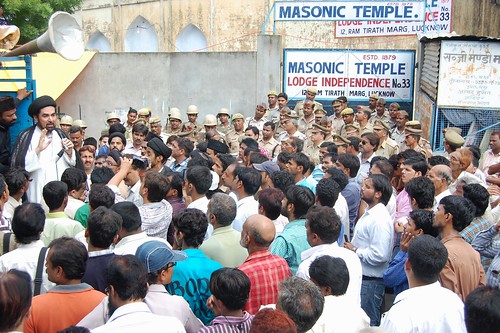
Masonophobia rears its ugly head in India - Lucknow Freemasons hall claimed to be Jewish temple and Shia Muslims stake claim to the property!!

Poor reporting by the Times of India has made a Freemasons hall in Lucknow seem to be a Jewish temple on which Muslims are staking a claim.  
http://twocircles.net/node/263284
Protest on 12th Sept 2011
Shia pressure group wants Jewish temple to be declared as waqf By Shailvee Sharda, TNN | Jan 9, 2013, 06.34 PM IST
LUCKNOW: The Freemasonry Jewish temple in the city is in the news all over again as a Shia pressure group have said the temple as a wakf (endowment) property. They have also demanded handing over the temple situated at Ram Tirath Marg in Hazratganj.
A few months ago, on 12 Sept. 2011, hundreds of Shia Muslims led by Maulana Kalbe Jawwad had staged a protest to stake claim over Freemasonic Temple. Shias said it be to a mausoleum of their Imams and presently being illegally occupied by Jews.
These Masonophobes* claim that Freemasonry is anti national and is engaged in subversive activities. Their leader Maulana Jawwad also had this to say:
"There should be a vigil over their activities. We do not want such organisations to stay in India. However, if the government is desirous they can hand over another suitable location to them,"
The Elder of Ziyon, (a blogger) had this to say about the situation:
It appears that Muslims in India believe that they have the right to any land they want through intimidation and false legal claims when in fact their only claim is based on a perceived loss of honor. The idea that "Jews" control an area that they regard as theirs is simply unacceptable. 
The property in question is actually the Freemasonic Temple located at 12, Ram Tirath Marg, Lucknow in India, where Lodge Independence No. 33 has been meeting on the 3rd Saturday of every month since 1879. It is not in any way a Jewish temple nor does it have any religious significance. Part of this confusion also stems from the delusion among some Muslims who believe Freemasonry to be Jewish.
For those who want to read about what Freemasonry really is please read my earlier post "Freemasonry - What is it?"

The Indian Express did a better job of reporting the matter and even has a quote from the Lodge secretary.
Mahesh Chandra, secretary of Lodge Independence No. 33, said the structure was established in 1879. “It was leased by the British to Lodge Independence in 1879 for 50 years and it has been there for a century. How can anyone come and ask us to vacate?” he asked.
Mahesh Chandra, who has been associated with the temple since 1974, said, “I have never seen any tombs in there. If they have any documentary proof, they should take a legal course.”
 Meanwhile the district administration seems to have a level head in the matter.
The district administration has refuted the Shia cleric’s claim. District Magistrate Anil Kumar Sagar states that neither Maulana Kalbe Jawad nor UP Shia Central Wakf board have provided any documentary proof about the land belonging to the wakf board. “Lodge Independence is established there for a long time and the district administration will not interfere in the matter as it is a private property, unless the wakf board provides any documentary proof,” he said.
Incidentally Lodge Independence No 33 is not the only Craft lodge under the Grand Lodge of India in Lucknow. There are four craft lodges in Lucknow one of them is even older than Lodge Independence No 33 —The Lodge Morning Star No 7, Lodge Independence No 33, UP Masters, No.134 and Bharat Jyoti, No.144. Interestingly, Anne Besant (Read more here) started the first Lodge for women in Benaras but it failed to take off.

*Note on new term "Masonophobe"
Anti-Masonry is a common and frequent pass-time and everyday somewhere in the world someone, some newspaper, some radio show etc. is attacking us, poking fun at us or accusing us of terrible crimes. I think that it is time to fight back Compared to Homophobe, anti-Semitic, Islamophobe etc. ‘anti-Masonic’ lacks any impact. I, and a few others, think that it is time use a more forceful word that makes it clear that an anti-Mason is actually someone who HATES Freemasons. Masonophobe does exactly that. It is just a suggestion but perhaps we Freemasons should all now stop using ‘anti-Mason and use Masonophobe instead - W. Bro. Robert Cooper

Friday, December 28, 2012

Saint John the Evangelist


Today December 27th is celebrated as St. John the Evangelist day.
So I thought I'd share some
 legendary information about St. John the Evangelist.
Saint John and the Poisoned Cup
by Alonzo Cano
Spain (1635-1637)

I saw this photograph and wondered what the serpent in the cup meant.

I did a little searching around and it threw up a lot of interesting bits of information about him.


  • The meaning of the name 'John' is "Yahweh is gracious" (Tiberian Hebrew Yôḥānān)
  • All the disciples of Christ were killed for their faith except John the Evangelist who died of old age.
  • The apostle John was considered one of the 'pillars' of the Jerusalem church.
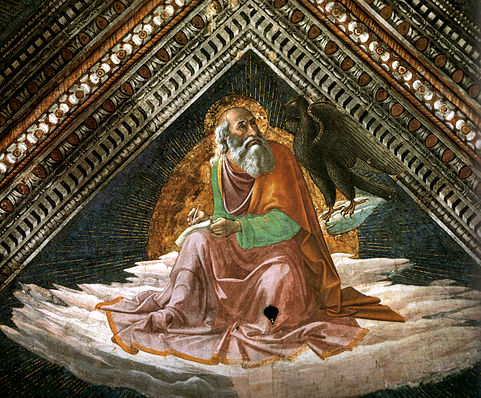
  • Christian art usually represents St. John along with an eagle, symbolizing the heights to which he rises in the first chapter of his Gospel.
  • In some pictures of him he is depicted as a young man which leads to the confusion of him as a woman, while in others he is painted as an old man with a long beard. This is because he lived a long and eventful life and died of old age.
  • The artists for some reason kept painting the Virgin Mary is almost always in a blue robe. Similarly inspite of the fact that in some pictures he was confused as a woman they kept painting John almost always in a pink robe! Which did nothing to add to the lack of 'masculinity' of the young 'beloved' disciple.
  • He is considered as one of the patron saints of Freemasonry. But he is also associated as the patron saint of Friendship, the book industry, protection from poison, and many places including Cleveland!

Getting back to my original question of the snake in the picture...
According to legend, when St. John was in Ephesus, he was asked to drink from a chalice of poisoned wine as a test of the strength of his faith (two men had already done so and died). When St. John blessed the cup,
the poison rose in the shape of a serpent. Another explanation is that this incident is tied to the words of Christ to John and James "My chalice indeed you shall drink" (Matthew 20:23)

Friday, November 23, 2012

XII World Conference of Masonic Grand Lodges & 51st Grand Festival of Grand Lodge of India

The 2012 Annual Grand festival of the Grand Lodge of India is special this year as it runs from November 21 until November 25th 2012 following the XII World Conference of Masonic Grand Lodges at Chennai in India.

Here are some pictures and videos from the event that I could gather.

I will post more as I find them :)


A big thank you to M. W .Bro. Andrey Bogdanov!! (
Grand Master of the Grand Lodge of Russia)

The invocation before the proceedings:


The traditional drummers welcome the delegates:

This sort of drumming accompanied by elephants in the form of a procession is an Indian traditional form of welcome for honoured guests.

The official logo

The venue from the outside


The elephant that was part of the welcome!
The Traditional Drummers to welcome the delegates 


The festive board and dinner area

Thursday, November 22, 2012

Freemasonry feared as the 'thalaivetti sangam' (group that decapitates) among some in India


Even as the XII World Conference of Masonic Grand Lodges is being held in Chennai India on November 22 and 23, the Grand Master of the Grand Lodge of India Capt. Dr. Balaram Biswakumar regrets the fact that even today Freemasons are feared as the 'thalaivetti sangam' (group that decapitates) among some people here. 
"We want to break this misconception and spread awareness on the precepts of our society," says Biswakumar, a Chennai-based neurologist.


Incidentally this is the second time an international event is being held in the country after the 2001 event was held at Delhi.