Showing posts with label wine. Show all posts

Sunday, February 19, 2012

A Freemasonic perspective on Alcohol - Water into wine

One of the differences that I came across when I experienced Freemasonry in America was the conspicuous absence of alcohol in any manner or form at the lodge premises. I sorely missed the "fun" festive boards of my mother lodge the Star of the South 101 GLI at these times.
This naturally got me curious. Was is something we were doing wrong back at home? Or was this some American innovation that I was experiencing? Not being one to sit around with doubts for a long time, I decided to find my own answers. I knew from experience that, to get answers - you need to ask questions. Although asking questions was not something most people enjoyed doing as sometimes they might come across answers that they did not like. I was determined however that this was something worth looking into.
My most favorite charge - the charge after initiation rang in my ears "As a Freemason, let me recommend to your most serious contemplation the Volume of Sacred Law; charging you to consider it as the unerring standard of truth and justice and to regulate your actions by the divine precepts it contains." It was clear to me that I needed to study the Bible to arrive at the truth of this matter. Therefore I began a systematic study of what the Bible had to say regarding the use of alcohol.
Essentially what I wanted to know was if drinking alcohol was a sin. As a Christian I am acutely aware one thing - for all have sinned, and fall short of the glory of God (Romans 3:23) Therefore I could not look at anyone else as an example other than Jesus himself for he was the one man who was without sin by virtue of  being God himself. So I looked at Jesus's life and came upon the first miracle attributed to Christ. The turning of water into wine at the wedding in Cana of Galilee. The following is the English Standard Version (ESV) of this event from John 2:1-11
The Wedding at Cana
1On the third day there was a wedding at Cana in Galilee, and the mother of Jesus was there. 2Jesus also was invited to the wedding with his disciples. 3When the wine ran out, the mother of Jesus said to him, “They have no wine.” 4And Jesus said to her,“Woman, what does this have to do with me? My hour has not yet come.” 5His mother said to the servants, “Do whatever he tells you.”
6Now there were six stone water jars there for the Jewish rites of purification, each holding twenty or thirty gallons.a 7Jesus said to the servants, “Fill the jars with water.” And they filled them up to the brim. 8And he said to them, “Now draw some out and take it to the master of the feast.” So they took it. 9When the master of the feast tasted the water now become wine, and did not know where it came from (though the servants who had drawn the water knew), the master of the feast called the bridegroom 10and said to him, “Everyone serves the good wine first, and when people have drunk freely, then the poor wine. But you have kept the good wine until now.” 11This, the first of his signs, Jesus did at Cana in Galilee, and manifested his glory. And his disciples believed in him."
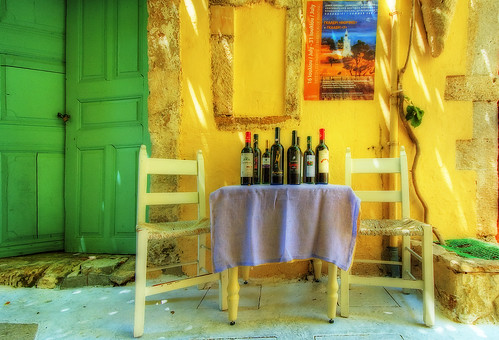
Looking at this I see that Jesus performed a miracle, turning water into wine. This showed beyond a doubt to his disciples that he was able to change the physical reality of things. To me this also afforded an example of Jesus's interaction with wine.
So now I needed to clarify - Did Jesus turn the water into wine (alcoholic) or into grape juice (non-alcoholic)? I went deeper into the text of the matter, and I found that the original word in Greek we translated into English as "wine" is oinos. This was the common Greek word for alcoholic wine. As I researched this topic I realized that some people would like to claim that oinos was actually just grape juice because Jesus would never give people wine to drink (Oh no!!) but that is clearly not the case because it is the same word  oinos used in Ephesians 5:18, "...18And do not get drunk with wine, for that is debauchery,..." Clearly, one can get drunk from drinking only alcoholic wine and not grape juice!
So there you have it. Not only did Jesus perform the miracle of turning water into wine he also made around 20-30 gallons of it in one shot!! So its not like he went for a party and took along a bottle of wine for the host. He made enough for the entire crowd at the wedding. This raised another question in my mind. Was Jesus giving everyone an unlimited drinks pass? Not at all according to me just because God gives us something freely does not give us a licence to abuse it!! Just like every other thing in life that the Almighty has provided for our nourishment, too much of it can be detrimental to our health. Here again our ritual teaches us regarding The cardinal virtues "As an individual, let me recommend the practice of every domestic as well as public virtue: let Prudence direct you, Temperance chasten you..."
So I learnt two things ultimately - that drinking alcohol is not a sin as long as it used with restraint or temperance. This exercise also intrigued me to find out what the bible says on alcohol. More on that in my apologetics blog.

Friday, March 5, 2010

The Cardinal Virtues

Freemasonry teaches us to also cultivate the cardinal virtues of prudence, temperance, fortitude and justice. They are second only to the theological virtues of faith, hope and charity (charity is derived from caritas which means love). Together they form the seven virtues of a righteous man.

The term "cardinal" comes from the Latin cardo or hinge; the cardinal virtues are so called because they are pivotal virtues and upon their practice the life of such a person "swings" favorably with God.
Early Christian leaders and theologians endeavored to codify a standard for human behavior based upon the bible that eventually came to be called the “cardinal virtues.” 
The Christian interpretation of the four cardinal virtues are the following:

  • Prudence - practical common sense, or making the effort to think about what you are doing and what is likely to come from it. Proverbs 22:3 says: A prudent man seeth the evil, and hideth himself: but the simple pass on, and suffer for it. Prudence is considered to be the auriga virtutum or the charioteer of the virtues. It confers upon another virtues the form of its inner essence; that is, its specific character as a virtue. For instance, not all acts of honesty are considered good, considering that honesty is a virtue in itself. What makes telling the truth a virtue is whether it is done with prudence. Telling a competitor the professional secrets of your company is not prudent and therefore not considered good and virtuous.
  • Restraint or Temperance - practicing self-control, and moderation. In the New Testament, the most common Greek word for self-control or temperance, is enkrateia. Its root meaning is "power over oneself" or "self-mastery." It is the virtue that holds our appetites in check, controlling our rational will or regulating our conduct without being duly swayed by sensuous desires. Temperance refers to all pleasures not just alcohol; and it did not mean abstaining, but going to the proper length and no further. Today there are some in the church who would equate temperance with just abstinence from drinking alcohol. But to me that is far from the truth, it is not ONLY about alcohol, it is also about men who obsess too much about their car, women who obsess too much about footwear. Proverbs 21:2 says: Every way of a man is right in his own eyes: but the LORD weigheth the hearts.
  • Courage or Fortitude - In Chronicles 28:20 "And David said to Solomon his son, Be strong and of good courage, and do it: fear not, nor be dismayed: for the LORD God, even my God, will be with thee; he will not fail thee, nor forsake thee, until thou hast finished all the work for the service of the house of the LORD." This actually refers to two types of courage, the first type that makes you strong to face your fears and the second type that you need to keep persevering in what ever you have set out to do. Fortitude is that character quality which empowers individuals to move beyond good intentions to the place where they become doers of virtuous things.
  • Justice - The justice of God is always an expression of His perfect, righteous, holy character. We should endeavor to emulate in our life. Its not the justice that is delivered in the courtroom that is being referred to here but "proper moderation between self-interest and the rights and needs of others". In a nutshell it would encompass all those things that we today would consider as "fairness" in life and actions.

Depictions of the Virtues

 The Cardinal Virtues are often depicted as female allegorical figures and were a popular subject for funerary sculpture. On the tomb of Sir John Hotham, in St Mary's Church, South Dalton the four figures are:
  • Justice - holding a sword.
  • Temperance - mixing wine and water in two jugs.
  • Fortitude - with a broken column.
  • Truth - holding a mirror and being attacked by a serpent.